The "As It Is" Understanding
Avoiding Misreadings of Śrīla Prabhupāda's Books

There are two words: exegesis and eisegesis, in terms of how a book can be read. Exegesis is the careful, disciplined practice of drawing out the true meaning of a text — asking what the author actually intended, in their own context, using their own words. It stands in contrast to eisegesis, where a reader projects his own ideas, assumptions, or agenda onto the text, making it say what he wants it to say rather than what it actually says.
From these definitions, it appears clear that exegesis is the desideratum and eisegesis is anathema. But the truth is more nuanced than this.
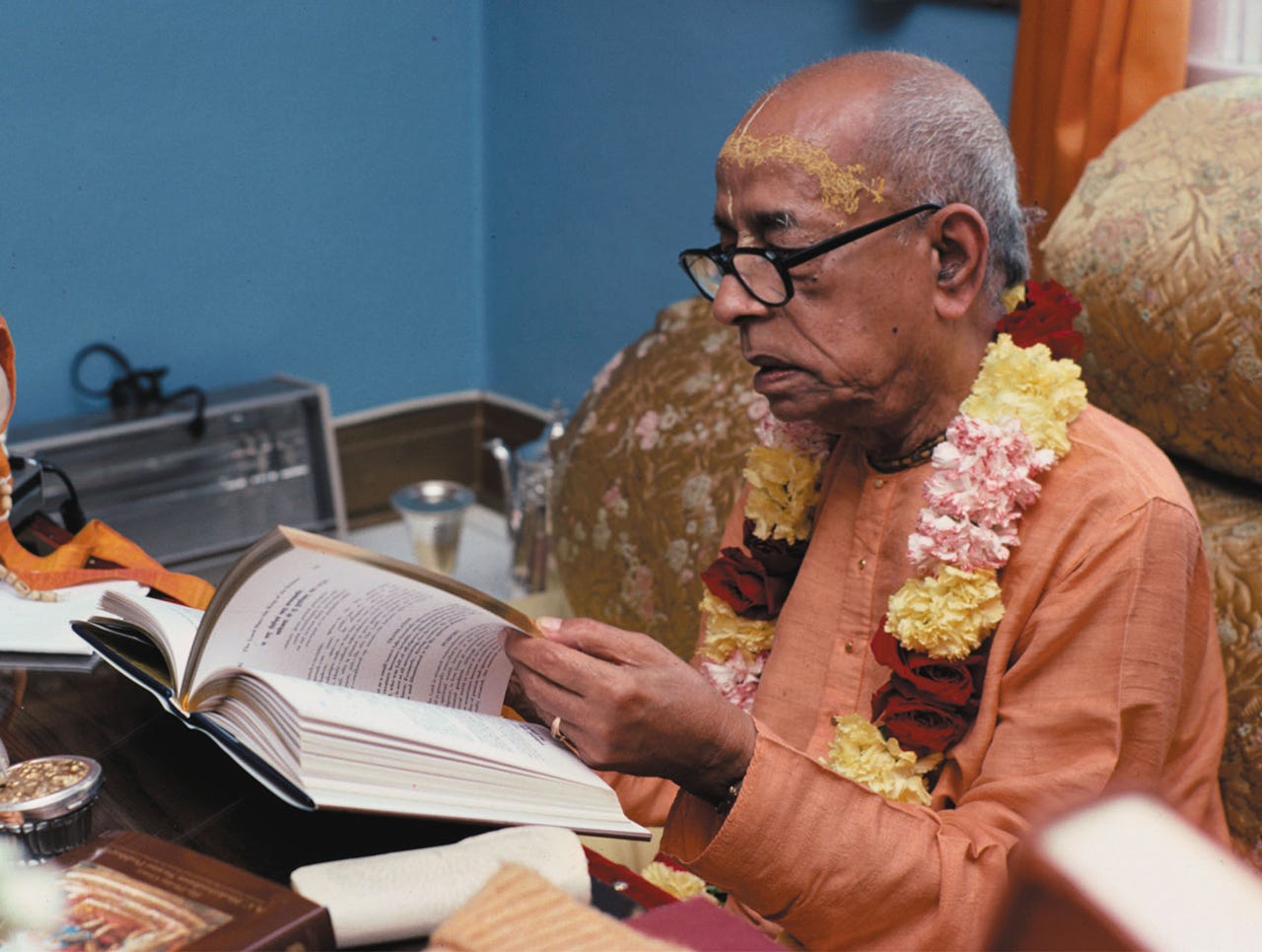
[Image: Śrīla Prabhupāda inspects a copy of Śrīmad-Bhāgavatam]
Let’s take the Bhagavad-gītā As It Is, for example. We can understand from Śrīla Prabhupāda’s books the intended message of Kṛṣṇa, in the context of that particular time, place, and circumstances in which it is spoken. This is technically exegesis. But classical texts — and Vedic scriptures like the Bhagavad-gītā above all — transcend geographical and epochal constraints. They are meant to be universally applicable. Therefore, exegesis with a healthy dose of eisegesis is required. Let us consider two verses of different types one of them being ontological, and the other being contextual.
First, let us consider this verse [Bhagavad-gītā 4.9]:
janma karma ca me divyam
evaṁ yo vetti tattvataḥ
tyaktvā dehaṁ punar janma
naiti mām eti so ‘rjuna
“One who knows the transcendental nature of My appearance and activities does not, upon leaving the body, take his birth again in this material world, but attains My eternal abode, O Arjuna.” This instruction is ontological and will remain eternally true for all contexts.
Now, let us consider the following verse [Bhagavad-gītā 2.37]:
hato vā prāpsyasi svargaṁ
jitvā vā bhokṣyase mahīm
tasmād uttiṣṭha kaunteya
yuddhāya kṛta-niścayaḥ
“O son of Kuntī, either you will be killed on the battlefield and attain the heavenly planets, or you will conquer and enjoy the earthly kingdom. Therefore, get up and fight with determination.”
This verse is contextual to that particular situation, on a battlefield, and also the particular recipient Arjuna, who was a kṣatriya. It is not to be followed by everyone literally, whether at that time or now. A fool may even radicalize himself into a terrorist if he tries to literally follow the instruction in the verse.
However, the verse highlights an underlying ontological point — performing one's duty will always be rewarding, no matter the external outcome. The definition of duty, again, in terms of varṇāśrama, is contextual and differs from and is subservient to the underlying eternal duty of servitude to the Supreme Personality of Godhead.
Śrīla Prabhupāda mentions in his song Vṛndāvane Bhajana [13.1]:
kṛṣṇera lāgiyā yabā nitya yuddha kare
ṛddhi, siddhi, jñāna tāra muṣṭira bhitare
“Whoever daily fights the battle of life only for Lord Kṛṣṇa’s sake discovers prosperity, mystic perfection, and transcendental knowledge in the palm of his hand.”
Here, Śrīla Prabhupāda refers to a metaphorical battle of life, which is universally applicable to everyone, comparing it to the battlefield of Kurukṣetra, which was specific to Arjuna at that time. In this instance, exegesis has to be applied and then the authorial intent is to be carefully extracted and applied to our particular context, which is in the realm of eisegesis, but is perfectly valid when applied by the pure devotee ācārya. This is one of the many functions of Śrīla Prabhupāda’s purports.
Furthermore, on an individual level, every devotee who reads Prabhupāda’s books experiences that the books seem to answer the particular individual questions that a devotee may have or may provide a very personal insight into such a devotee’s situation. While this may appear to be eisegesis by literary standards, it is entirely legitimate. Such legitimate eisegesis necessitates exegesis first. Only then can a principle be properly detached from its original context and applied universally.
The Caitanya-caritāmṛta [2.24.318] states:
kṛṣṇa-tulya bhāgavata—vibhu, sarvāśraya
prati-śloke prati-akṣare nānā artha kaya
“Śrīmad-Bhāgavatam is as great as Kṛṣṇa, the Supreme Lord and shelter of everything. In each and every verse of Śrīmad-Bhāgavatam and in each and every syllable, there are various meanings.” Lord Caitanya famously explained the ātmārāma verse ['Śrīmad-Bhāgavatam 1.7.10] in sixty-one different ways. All of them are “As It Is.”
But all such ever-fresh and ever-new confidential understandings of Vedic literature, moving seamlessly between exegeses and eisegeses, but never deviating from the true purports of the books, are only possible through unflinching faith in, and service to the bona fide spiritual master and Kṛṣṇa. Śvetāśvatara Upaniṣad [6.23] states:
yasya deve parā bhaktir
yathā deve tathā gurau
tasyaite kathitā hy arthāḥ
prakāśante mahātmanaḥ
“Only unto those great souls who have implicit faith in both the Lord and the spiritual master are all the imports of Vedic knowledge automatically revealed.”
Śrīmad-Bhāgavatam [2.9.31] similarly emphasizes:
śrī-bhagavān uvāca
jñānaṁ parama-guhyaṁ me
yad vijñāna-samanvitam sarahasyaṁ
“The Personality of Godhead said: Knowledge about Me as described in the scriptures is very confidential, and it has to be realized in conjunction with devotional service.”
To brazenly impose one’s own ideas, assumptions, or agenda onto a text — with no regard for authorial intent — is to do scripture the gravest disservice: misunderstanding it, misapplying it, and misrepresenting it, and in so doing, spreading untruth. This should carefully be avoided completely.
Hare Krishna Prabhu, i got lost after the 2nd paragraph, need to take dictionary.
1) SB 6.4.29, Translation
Anything expressed by material vibrations, anything ascertained by material intelligence and anything experienced by the material senses or concocted within the material mind is but an effect of the modes of material nature and therefore has nothing to do with the real nature of the Supreme Personality of Godhead.
2)foolish, impersonal philosophers consider themselves supreme, they are unable to appreciate that loving service exists on the spiritual platform. Stubbornly rejecting subservience to the Personality of Godhead, the impersonalists are eventually overwhelmed by the illusory potency of the Lord and undergo the miseries of material existence. The Vaiṣṇavas, on the other hand, are not envious of the Personality of Godhead. They gladly accept His shelter and supremacy, and thus the Lord personally takes charge of His devotees and enlightens them, filling them with His own transcendental bliss. Spiritual service to the Supreme Lord is in this way free from the disappointment and repression of material service.
SB 11.22.10 : Purport